

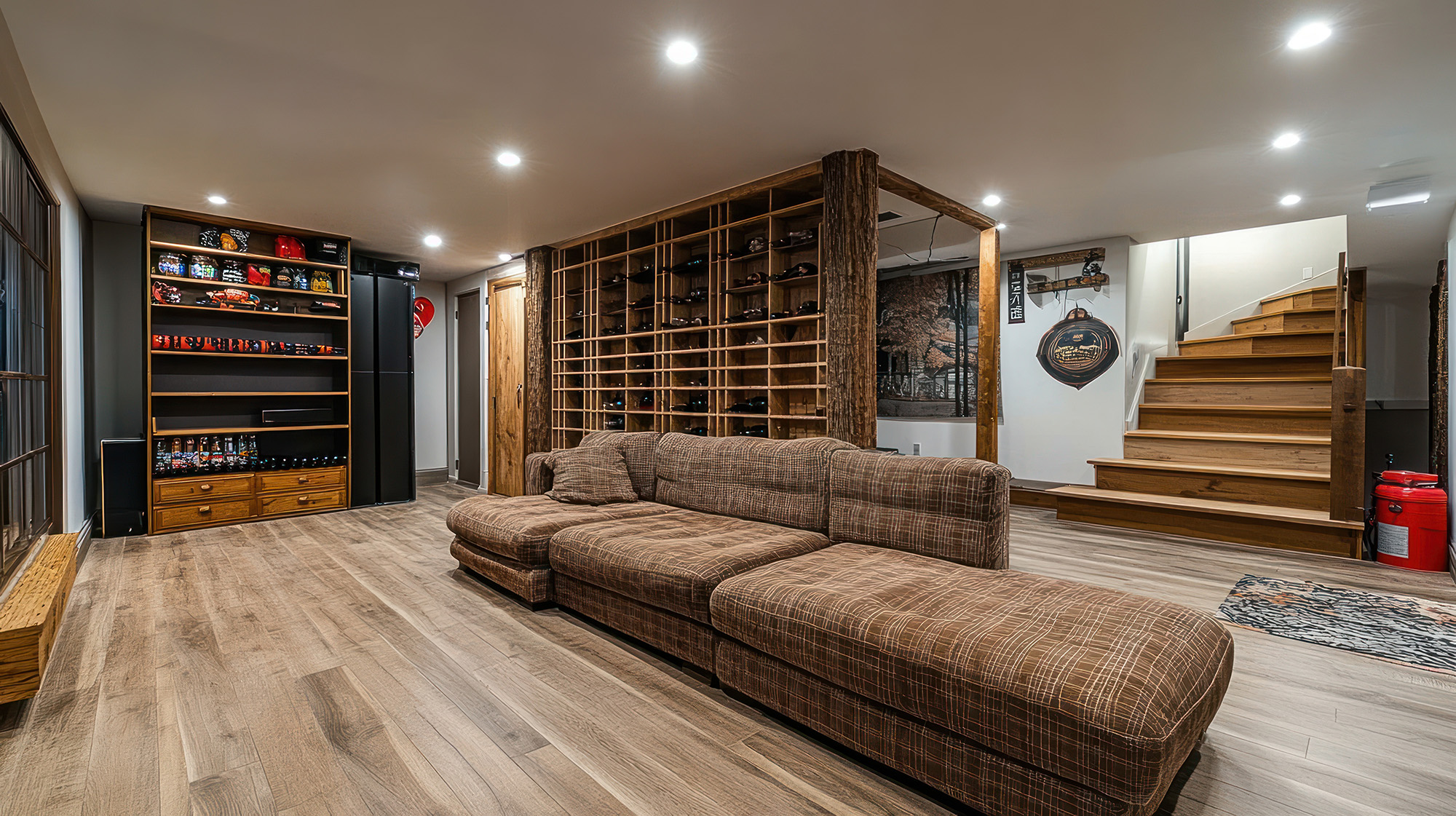
Lower-level renovations add usable living space to your home, but raw concrete foundations present hidden moisture problems that ruin new floors if left unaddressed.
Basement slabs in Mason and Montgomery sit below grade, where ground dampness continually migrates upward through porous concrete, and uninsulated slabs draw heat straight out of the room. You must protect laminate floors with a dedicated vapor barrier, high-density padding, and a thermal break before laying a single plank.
A standard thin foam pad will fail in a basement setting because below-grade installations call for moisture defense and thermal insulation from day one.
Concrete Moisture Risks Beneath Below-Grade Laminate
Concrete looks completely solid on the surface, but it behaves like a dense sponge that pulls moisture from the surrounding soil. Lower levels in suburban Cincinnati homes face constant hydrostatic pressure, especially during rainy spring seasons.
Ground Vapor Migration Through Porous Concrete
Microscopic water vapor constantly travels upward through porous concrete slabs into your living space. Standard laminate boards placed over bare concrete trap the rising moisture against the bottom of the planks. The high-density fiberboard core absorbs this trapped water, which causes the edges of the boards to swell, peak, and separate along the seams. A dedicated six-mil polyethylene vapor barrier stops this moisture from ever reaching your finished floor. Professional installers overlap every underlayment seam by at least eight inches and seal the joints with moisture-resistant tape to build an airtight moisture defense.
Hidden Problems Revealed by Calcium Chloride Testing
A dry-looking slab can still emit high volumes of invisible vapor that destroy laminate locking systems over time. Professional installers test concrete moisture emission rates with calcium chloride kits or relative humidity probes before laying down any flooring materials. These diagnostic tests measure the precise amount of moisture evaporating from the slab over a seventy-two-hour testing window. High moisture readings show that your project needs a specialized heavy-duty vapor barrier system rather than standard foam padding. Skipping this diagnostic test often leads to mold growth and ruined planks within the first year of installation.
Essential Components of Basement Laminate Underlayments
Suburban basements in Montgomery and Mason need underlayment systems engineered specifically for below-grade concrete conditions. High-performing basement underlayments combine three protective functions into one durable layer:
Integrated Six-Mil Vapor Barriers: Heavy-duty polyethylene backing stops moisture migration from reaching the wood-fiber laminate core.
Closed-Cell Polyolefin Foam: Dense closed-cell construction resists water absorption and maintains its structural shape under heavy pressure.
Taped Seam Systems: Factory-applied adhesive strips and wide overlapping film edges prevent vapor leaks between neighboring underlayment rolls.
Dense Core Support: High-compression resistance supports click-lock joints under heavy furniture and prevents vertical flexing when you walk across the room.
Thermal Break Needs for Cold Ohio Basements
Southwest Ohio winters bring freezing ground temperatures that turn concrete basement slabs into cold sinks. A proper thermal break underlayment prevents that cold energy from penetrating into your finished living areas.
Cold Transfer Through Uninsulated Concrete Slabs
Bare concrete pulls heat directly out of your basement rooms through continuous thermal conduction. Warm indoor air meeting a cold floor surface creates chilly rooms that feel uncomfortable throughout the winter months. Dense foam underlayment acts as a physical thermal break, slowing down the transfer of cold energy from the ground into your living space. This extra thermal resistance helps your heating system keep the basement comfortable without running constantly. An underlayment with a proven thermal rating gives you a noticeably warmer floor beneath your feet during cold winter stretches.
Condensation Risks from Seasonal Temperature Swings
Humid Cincinnati summers create wide temperature gaps between warm indoor air and cold foundation concrete. Moisture condenses into liquid water droplets underneath the flooring whenever humid air hits a cold surface. Standard underlayments without a built-in thermal barrier let this condensation pool between the slab and the floor planks. Specialized thermal underlayments insulate the concrete, keeping the floor surface temperature above the dew point so condensation cannot form. This continuous protection stops hidden mold, mildew, and subfloor damage before it starts.
Trust Bush Flooring Center for the Right Basement Underlayment
A specialized underlayment system protects your laminate from concrete moisture vapor and keeps your finished basement warm across all four seasons.
Bush Flooring Center has helped homeowners throughout Mason, Montgomery, and the greater Cincinnati area select durable, long-lasting floors since 1987. Our team brings nearly four decades of hands-on installation experience to every project, making sure your subfloor gets the exact moisture testing and vapor protection it needs before installation starts.
Contact us today to plan your basement renovation, or visit our showroom at 1940 Dana Avenue to explore our basement-ready laminate flooring and professional-grade underlayments.


