

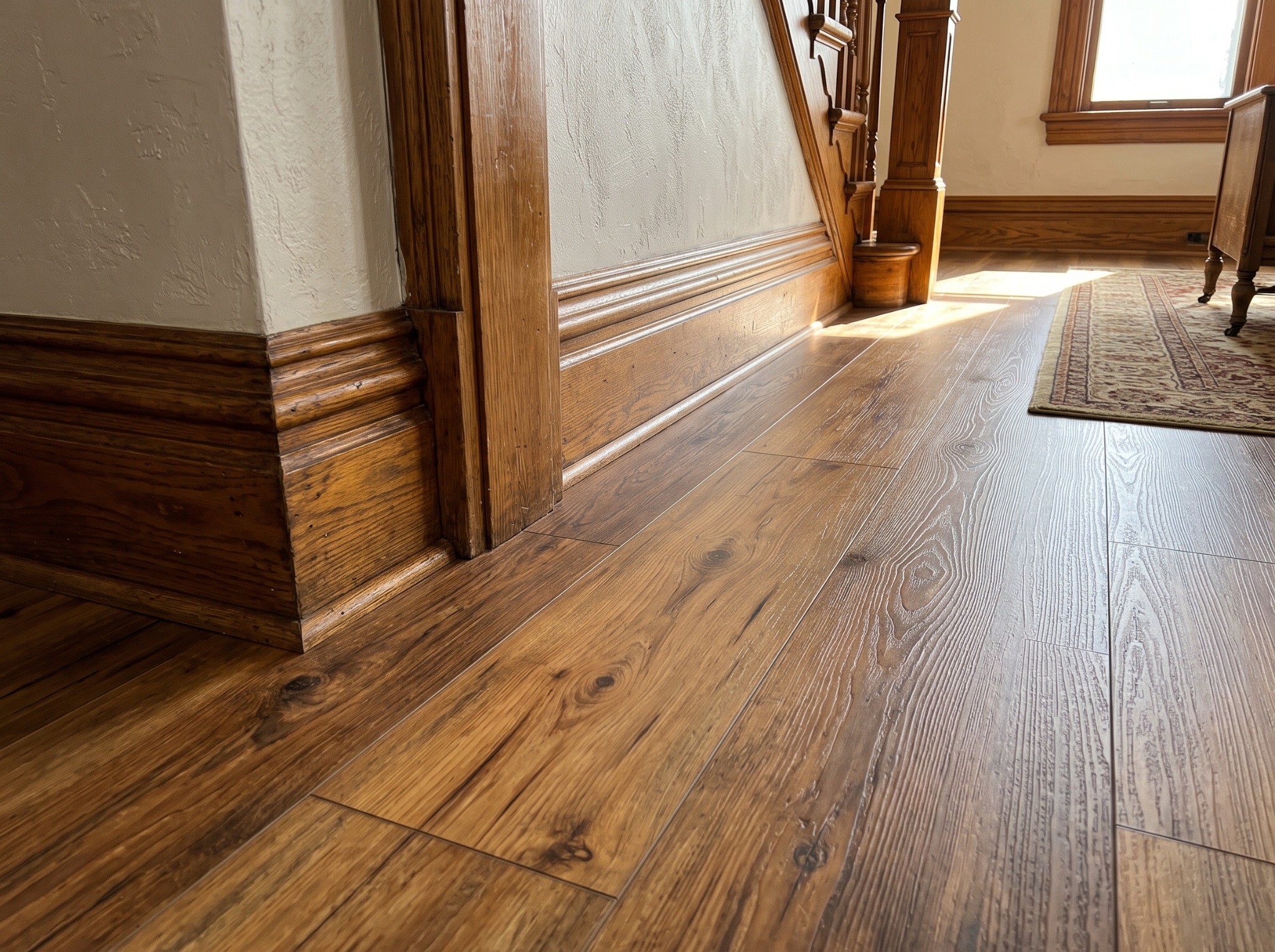
When you live in an older home with original woodwork, preserving that architectural soul is often your highest priority. Whether you are restoring a century-old Victorian in Cincinnati, updating a classic Craftsman bungalow in Loveland, OH, or preserving vintage charm in an established neighborhood across Montgomery or Mason, your original baseboards, grand door casings, and built-in millwork give your space irreplaceable warmth and timeless character.
Finding a modern floor that honors historic craftsmanship without demanding high-stakes maintenance can feel tricky. Solid hardwood reacts dramatically to our humid Ohio summers and dry, cold winters. When you want worry-free durability without sacrificing historic authenticity, modern luxury vinyl plank (LVP) offers an outstanding solution, specifically Embossed-in-Register (EIR) vinyl planks.
Here is what you need to know about pairing authentic historic trim with the natural texture and resilience of Embossed-in-Register vinyl planks so your rooms feel cohesive, elegant, and timeless.
Understanding Embossed-in-Register (EIR) Technology
Standard luxury vinyl flooring uses a flat or generic mechanical texture stamped across a printed wood grain image. While it looks attractive from across the room, your eyes and fingers instantly notice when natural daylight hits the floor. The light reflects uniformly across the surface, breaking the illusion of real lumber.
Embossed-in-Register technology solves this problem by aligning the physical surface texture directly with the high-definition photographic print underneath:
Synchronized Grain and Knots: In an EIR plank, every physical groove, knot, and fine wood pore lines up with the visual film beneath the wear layer. When your eye catches a knot or cathedral grain pattern, your fingertips feel the exact texture you see.
Natural Light Reflection: Sunlight streaming through your historic windows catches realistic shadows inside the textured grain lines. This eliminates the artificial plastic sheen typical of entry-level vinyl flooring.
Authentic Tactile Depth: EIR planks deliver the subtle, varied texture of authentic wire-brushed or hand-planed timber while remaining completely waterproof, scratch-resistant, and easy to clean.
Realistic Beveled Edges: Many premium EIR planks feature micro-beveled or painted bevel edges that define each individual plank, replicating the distinct dimensional profile of traditional tongue-and-groove boards.
When you install EIR luxury vinyl next to original quarter-sawn oak, dark walnut, or antique heart pine baseboards, the synchronized grain keeps the vinyl from looking artificial against authentic aged wood.
Why Tri-State Homes Benefit from Luxury Vinyl Beside Historic Woodwork
Original homes throughout Cincinnati and neighboring communities such as Loveland, Mason, and Montgomery face dramatic seasonal climate shifts. Between humid July afternoons and freezing January mornings along the Ohio River Valley, indoor humidity levels rise and fall continuously.
Traditional solid wood floors expand and contract during these humidity swings, leading to winter gaps, seasonal cupping, and creaky floorboards. If your home has historic trim installed tightly to the original subfloor, swelling wood can place pressure on delicate baseboards and door casings. Furthermore, damp basements common throughout older Tri-State neighborhoods often push moisture into ground-level subfloors.
EIR luxury vinyl planks provide complete dimensional stability. Built with dense composite cores, such as WPC (wood-plastic composite) or rigid stone-polymer composites, these planks resist moisture swings, seasonal expansion, and heavy daily foot traffic. You get the rich visual warmth of historic timber without worrying about moisture warping your subfloor, ruining your investment, or pressing against antique millwork.
Rules for Matching EIR Vinyl Planks with Historic Wood Trim
You do not need an identical wood match to make your room look beautiful. In fact, trying to copy an aged, ninety-year-old wood stain exactly with a modern printed plank can often backfire. Wood darkens, ambers, and develops a rich patina over decades of sunlight exposure and care, making an exact match nearly impossible. Instead, use these proven design strategies to achieve a balanced, intentional look.
1. Match the Undertone Rather Than the Exact Stain
Look closely at your door casings, window frames, and baseboards in natural daylight. Do they carry warm honey tones, deep reddish-amber notes, golden hues, or cool espresso browns?
Choose an EIR plank that shares the same color temperature as your woodwork. For example, if your Montgomery home features rich chestnut trim with golden-red undertones, choose a floor with subtle warm amber highlights. If your trim has cooled down to an antique walnut brown, look for planks with earthy, neutral undertones. When undertones match, slight variations in lightness or darkness look deliberate and harmonious.
2. Create Intentional Visual Contrast
If your trim is deep dark oak or dark walnut, you do not have to darken your entire home with matching dark floors. In fact, pairing dark trim with a medium-toned or light-neutral EIR plank creates crisp visual definition and makes rooms feel much larger. The synchronized grain of EIR flooring gives the planks enough organic texture to hold their own alongside bold, heavy wood trim without competing with it.
3. Coordinate Sheen Levels and Surface Patina
Historic wood trim usually possesses a soft, satin, or hand-rubbed oil patina developed over decades of care. High-gloss floors create an immediate stylistic clash against vintage woodwork, making the floors look synthetic. When you explore plank options in our showroom, look for low-gloss, ultra-matte, or satin EIR finishes. A matte finish absorbs light similarly to vintage architectural millwork, tying your baseboards and floors into a unified visual plane.
4. Mind the Plank Width and Grain Scale
Historic homes often feature trim with tight grain lines, intricate profiles, and hand-carved details. Selecting an EIR plank with subtle, natural wire-brushed grain and moderate plank widths (five to seven inches) tends to complement historic millwork best. Overly wide, rustic barn-wood planks loaded with exaggerated saw marks can overwhelm classic architectural details. Clean, authentic EIR texturing lets your woodwork remain the star of the room while providing a quiet, dependable foundation underfoot.
Installation Techniques to Protect Antique Millwork
Installing modern vinyl plank next to antique woodwork requires expert care, especially in older Tri-State homes where floors settle over decades:
Subfloor Leveling: Older homes rarely have perfectly level subfloors. Thorough subfloor prep, including smoothing out high spots and filling low dips, ensures your vinyl planks lock together tightly without flex, bounce, or hollow sounds underfoot.
Preserving Your Baseboards: Removing antique, fragile wood baseboards can crack or split them beyond repair. Our experienced local installation team knows how to install flush shoe molding or quarter-round color-matched to your trim or floors, giving your new planks room for normal perimeter expansion while keeping your original woodwork intact.
Sound-Dampening Acoustic Underlayment: Adding a quality underlayment or choosing EIR planks with attached sound-dampening pads gives your floor the solid, quiet walking feel expected in a quality vintage home.
Undercutting Door Jambs with Precision: Rather than cutting vinyl planks clumsily around detailed historic door casings, our installers carefully undercut the jamb bottoms, allowing the planks to slide underneath for a clean, built-in appearance.
Ready to find the best flooring for your style and budget? Stop by our showroom and discount outlet warehouse in Cincinnati, book a Shop at Home visit, or give our team at Bush Flooring Center a call to schedule your in-home estimate. We proudly serve you across Cincinnati, Montgomery, Mason, and Loveland, OH.
Frequently Asked Questions
Can you install EIR vinyl planks directly over original hardwood floors?
Yes, as long as your existing wood floors are structurally sound, flat, and securely fastened to the joists. High-quality EIR planks float easily over stable wood subfloors without nails or glue, protecting the original wood underneath if a future homeowner ever wishes to uncover it.
Will luxury vinyl planks look out of place next to century-old wood trim?
Budget vinyl with a repetitive, shiny surface can clash with real wood. However, high-quality Embossed-in-Register planks sync physical textures directly to the underlying visual grain pattern. In natural daylight, the authentic depth, matte sheen, and realistic texture blend seamlessly alongside genuine hardwood molding.
How do you transition between original hardwood rooms and new vinyl planks?
We recommend using low-profile, color-matched transition reducers or T-moldings. By sticking to matching undertones, you create a smooth, natural threshold crossing from an original hardwood hallway into an updated vinyl kitchen, bathroom, or living area.
What core construction works best for older Tri-State homes?
Rigid core and WPC waterproof vinyl planks are both excellent choices. WPC offers a slightly softer, warmer feel underfoot, which works nicely over older, colder subfloors during chilly winters. Rigid stone-polymer core (SPC) provides maximum resistance to heavy furniture indents and seasonal temperature shifts.


